

Results of the 2026 conference
09.09.2026
Dear friends and colleagues!
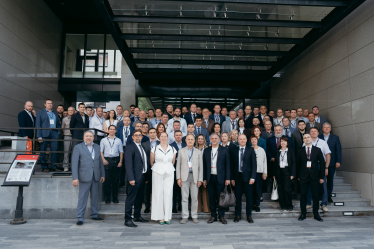
Our two-day scientific and technical marathon has now come to an end. The conference was attended by over one hundred representatives of large and small production companies, manufacturers of rolled metal and pipe products, design institutes, research centers, and leading polytechnical universities of the country. I hope that all participants of our event gained a great deal of useful theoretical and practical information.
The main goal of our annual conference is to create a platform for communication among metallurgists, oil and gas production specialists, manufacturers of process equipment, university researchers, and engineering center professionals. The key issue on the agenda is corrosion and methods of combating it. In our view, this goal has been achieved.
On the first day of the conference, discussions covered the study of root causes of failures in oilfield equipment and pipeline systems of various material compositions, as well as the specific features of failure of submersible equipment components during well treatment operations. IT approaches were not overlooked — geoinformational analysis of corrosion risks in oil gathering systems, prediction of complications, and the development of predictive analytics tools.
We carefully examined technologies for replacing steel pipelines with flexible polymer reinforced pipe systems (FPRS), the experience of using FPRS at oil gathering facilities and reservoir pressure maintenance (RPM) systems complicated by highly aggressive media.
Issues of corrosion protection for production, treatment, and oil and gas transportation facilities were discussed, and the corrosion resistance of steels and alloys was assessed both through laboratory tests and under specific operating conditions in H₂S-containing environments.
The first day of the conference concluded with a walking tour of Samara's historic center, which has preserved its merchant architecture from the late 19th – early 20th centuries.
Guests were able to feel the atmosphere of old streets, walk along Samara's main street of the late 19th century, which was rightly called an "exhibition of public life," visit ancient courtyards and modern art spaces.
The second day of the conference also proceeded in a productive working atmosphere.
There was active discussion on the use of protective coatings at oil and gas production facilities, new construction technologies, protection of the internal surface of pipes, the use of weldless pipe joints (cone-socket type connections), and the effectiveness of protective gas-flame coatings for process equipment operating at high temperatures in corrosive environments.
Issues of alloying steels to improve their corrosion resistance, the specifics of selecting them for oil and gas production process equipment, as well as the selection of inhibitors to protect metal from hydrogen embrittlement, were not forgotten.
The second half of the day was entirely devoted to composite materials and technical solutions for the construction of FPRS pipelines. Representatives of SIBUR set the tone for the discussions by reporting on standards, methodology, and new grades of reinforced polymer pipes. The Nonmetals Research Center dedicated all its presentations to testing and research on FPRS — ranging from certification and diagnostics to determining chemical resistance and changes in the physical and mechanical properties of elastomers and thermoplastics under the influence of chemically active media.
The FPRS manufacturing plants were equally engaged, speaking about the development of FPRS technology and related design, construction, and operational tools, the advantages of reinforcing products with polymer tape instead of steel tape, and the need for mandatory technical supervision of FPRS operations.
In our opinion, the event was dynamic, interesting, and, we hope, useful. We, the conference organizers — IT-Service LLC, Engineering Practice LLC, and Nonmetals Research Center LLC — thank all speakers for their significant contribution to the program. We thank the conference participants for their engagement and challenging questions. We are always open to creating new formats of communication. We welcome suggestions and feedback. And, of course, we look forward to seeing everyone in the first ten days of September 2027 at the 11th Scientific and Technical Conference. We are growing up — entering our second decade.
Until we meet again!
Organizing Committee